Is 84% of AI Citations Really Earned Media?
· Published August 4, 2026 · Updated August 19, 2026 · 4 min read
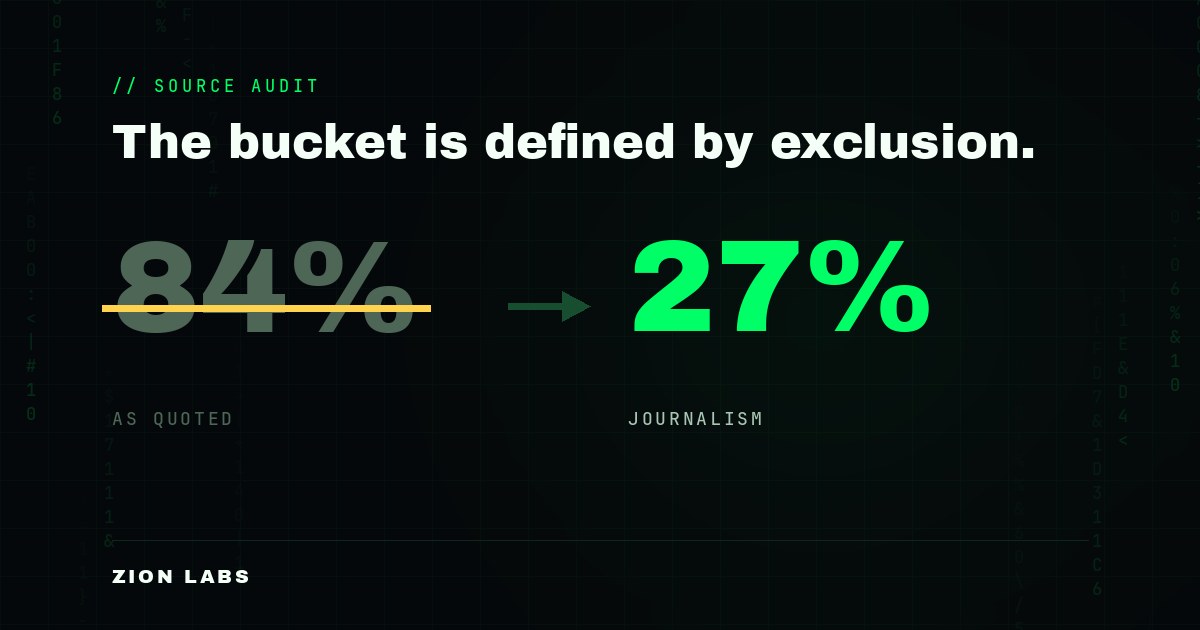
The figure as commonly quoted: 84% of AI citations are earned media, therefore digital public relations is the highest leverage channel in AI search.
The number is real and the sample is large. The word doing the work is “earned”.
What the source actually measured
Muck Rack runs Generative Pulse, an ongoing measurement of what AI models cite. Two editions matter here.
| Generative Pulse edition | Sample | Earned media | Journalism | Also reported |
|---|---|---|---|---|
| May 7, 2026 | 25 million+ links, ChatGPT, Claude and Gemini, 17 industries | 84% | 27% | Paid or advertorial 0.3% |
| December 2, 2025 | 1 million+ links, ChatGPT, Claude, Gemini and Perplexity, July to December 2025 | 82% | about 20% to 30% | Non-paid sources 94% |
The two editions are consistent with each other. Nothing here suggests an unstable measurement.
Where the quoted version and the source diverge
The instability is in the bucket, and it is visible in the arithmetic of Muck Rack’s own release. 94% non-paid minus 82% earned leaves roughly 12% for owned content.
Earned media here is a category defined by exclusion: everything that is neither the brand’s own site nor a paid placement. That necessarily holds a great deal more than press coverage. Forums, review sites, aggregators, directories, community wikis and comparison pages all land in it, because none of them is owned and none of them is paid.
Journalism, the thing a public relations retainer actually buys, is reported separately at 20% to 27% across three editions since July 2025. The gap between 84% and 27% is not measurement error. It is the difference between “not yours and not bought” and “written by a journalist”.
Two smaller numbers in the same tables deserve more attention than they get. Paid or advertorial placement came in at 0.3% in the May 2026 edition, which is close enough to zero that buying your way into an AI answer through advertorial is not currently a working strategy at any scale these engines cite. And the roughly 12% left for owned content, derived from Muck Rack’s own December arithmetic, is the share held by one domain per brand against the entire rest of the web.
The same programme has already produced both headlines. On March 30, 2026, LeadCoverage issued a release on Muck Rack’s December report headlined “New Research Finds Earned Media Accounts for 25% of All Large Language Model Citations”. Same programme, same data, a headline roughly a third the size, because the narrow bucket was chosen instead of the broad one.
So one measurement now supports two figures in active circulation, 84% and 25%, both technically sourced to Muck Rack. Neither is wrong. They answer different questions, and which one you meet depends on who is selling to you.
One limit on our own check
Muck Rack’s blog post returns a 403 to automated fetching, so we read the figures from the GlobeNewswire releases and from coverage of them rather than from the post itself. The classification method behind the buckets is not published in the releases, and we have not seen it. That matters more than usual here, because the entire question is where the boundary of a bucket sits.
The honest version of the claim
There are two defensible sentences and they support different arguments.
If you are being sold digital public relations on the strength of “84% of AI citations are earned media”, the number relevant to that pitch is 27%, because press coverage is what the retainer produces and press coverage is the narrow bucket.
If the argument is the broader one, that a brand’s own site is a minority of what gets cited almost everywhere it has been measured, then 84% is fine, and it is also not news. Every other study in this audit finds the same thing, including the AirOps 85% figure and Aleyda Solis’s cross-vertical analysis. A number that agrees with everything else in the field is not a reason to change your budget.
The test to apply: ask what a bucket excludes rather than what it includes. A category defined by exclusion will always be larger than the thing you are being sold.
This page is part of Where the AI Search Statistics You Keep Quoting Actually Came From, an audit of seven of the most repeated figures in AI search optimization, with the checks we run on each one.