Do 85% of AI Brand Mentions Come From Third-Party Sources?
· Published August 4, 2026 · Updated August 19, 2026 · 4 min read
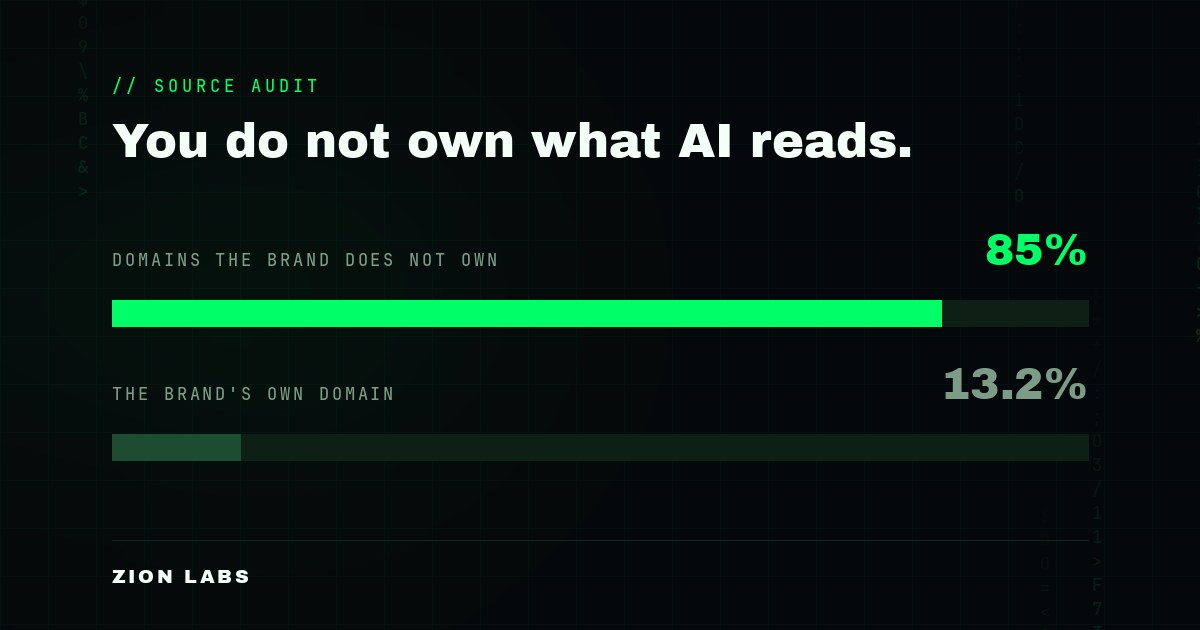
The figure as commonly quoted: 85% of brand mentions in AI search come from third-party sources, therefore off-site presence decides whether AI recommends you at the moment of purchase.
That sentence has two halves. The first half is accurate. The second half is an inference the underlying sample cannot carry.
What the source actually measured
The source is AirOps, The Influence of Offsite Signals in AI Search, published October 17, 2025.
| Publisher | AirOps |
| Date | October 17, 2025 |
| Sample | 21,311 brand mentions |
| Engines | ChatGPT, Claude, Perplexity |
| Queries | More than 500 commercial-intent queries |
| Categories | MarTech, Sales, HR and Finance, Productivity and Collaboration |
| Finding | 85% of brand mentions came from external domains, 13.2% directly from the brand’s own domain |
By the standards of this literature the report behaves well. It is open, it is dated, it states its sample, and it scopes itself explicitly to visibility during discovery and early vendor consideration. Its example queries are of the “best HR software” and “top CRM platforms” shape. Its own landing page keeps the scope in the title: third-party sources drive 85% of brand discovery.
Where the quoted version and the source diverge
The divergence is a single missing clause, and it moves the finding from one end of the funnel to the other.
Kevin Indig’s State of AI Search Optimization 2026, published January 5, 2026, carries the figure into its eighth factor as 85% of brand mentions for high purchase-intent prompts, and builds a gradient on top of it: external validation weighs more heavily the closer intent comes to a purchase decision.
That gradient is a reasonable hypothesis and it may well be true. The AirOps sample does not test it, because the sample sits at the discovery end. A study of “best CRM platforms” queries cannot tell you what happens when a buyer is choosing between two shortlisted vendors, and it does not claim to.
The drift does not start there. AirOps restates its own figure several ways across its own blog:
- One article, on enterprise AEO strategy, renders it as 85% of the signals influencing AI citation decisions coming from off-site sources. That converts a descriptive share of where mentions were observed into a causal claim about what drives a citation decision. Nothing in the report measures that.
- Another AirOps article states it as 85% of top-of-funnel B2B brand mentions, which is more precise than the report’s own headline.
So the publisher holds three versions of its own number, and the least defensible of the three is the one that travels furthest, because a causal claim is more useful in a pitch than a descriptive one.
The other half of the split is worth saying out loud too. If 85% of mentions came from external domains, 13.2% came from the brand’s own, and a brand’s own domain is one site competing against every other domain on the open web. A single site holding an eighth of all mentions in its category is a concentrated position, not a marginal one. The 85% is usually deployed to argue that owned content barely matters, and the same measurement says the opposite about it per domain.
The honest version of the claim
Quote it with its funnel stage attached, or do not quote it:
In discovery and early vendor consideration queries, AirOps measured 85% of brand mentions coming from external domains, across 21,311 mentions in October 2025.
That is a sentence you can defend in a room. It still supports a real strategic point, which is that a brand’s own site is a minority of what gets mentioned during discovery, and that off-site presence is therefore not optional. What it does not support is a claim about the moment of purchase, because nobody measured that.
Two practical tests before you use it. First, ask whether the argument you are making is about discovery or about decision, and if it is about decision, this is not your evidence. Second, if you see the figure stated as a share of signals or of citation decisions rather than of mentions, that version has been through at least one hop of drift, whoever published it.
This page is part of Where the AI Search Statistics You Keep Quoting Actually Came From, an audit of seven of the most repeated figures in AI search optimization, with the checks we run on each one.