Do 76% of AI Overview Citations Come From the Top 10?
· Published August 4, 2026 · Updated August 19, 2026 · 3 min read
The figure as commonly quoted: 76% of AI Overview citations come from the top 10, therefore classic ranking still drives AI visibility.
The 76% is real and correctly reported. The problem is that it answers a different question from the one people quote it for, and the publisher that produced it has since published two lower numbers of its own.
What the source actually measured
The 76% is Ahrefs, July 2025: 76.10% of AI Overview cited pages rank in the top 10, across 1.9 million citations from 1 million AI Overviews, looking at the three most visible citations in each response. Ahrefs’ own caveat is that this is a moderate correlation, not causation.
Note the unit. It is a property of the pages that got cited, not a share of the citations in a given answer.
The same publisher, two later numbers
38%. By early 2026 Ahrefs reported that only 38% of cited pages rank in the top 10 for the same query. Ahrefs attributes part of that fall to improved citation detection in its own tooling, and says the two datasets are not directly comparable. So the gap is partly a real change in Google’s behaviour and partly better instrumentation, and Ahrefs is explicit that you cannot read it as a clean trend.
12%. In a separate study of 15,000 long-tail queries, Ahrefs found that only 12% of AI-cited URLs rank in Google’s top 10 for the original prompt. Perplexity is the outlier at 28.6%; ChatGPT, Gemini and Copilot sit near 8%.
That last one is the closest thing anyone has published to the question people mean when they quote the 76%.
Why the numbers diverge
They are measuring different things, and one of them accounts for how the engines actually work.
- The 76% and 38% ask: of the pages that got cited, what share happen to rank in the top 10?
- The 12% asks: of the URLs an AI cited, what share rank in the top 10 for the prompt the user typed?
The second is harder and lower, because of query fan-out. An assistant retrieves against several rewritten versions of your question, so a page ranking around sixth for three related phrasings can be cited over a page ranking first for one. Ahrefs states this directly rather than leaving it implicit.
This matters because the fan-out gap is the whole story. A page can be cited from rank 40, or from nowhere in the top 100, and still be the answer.
A third source, disagreeing with itself
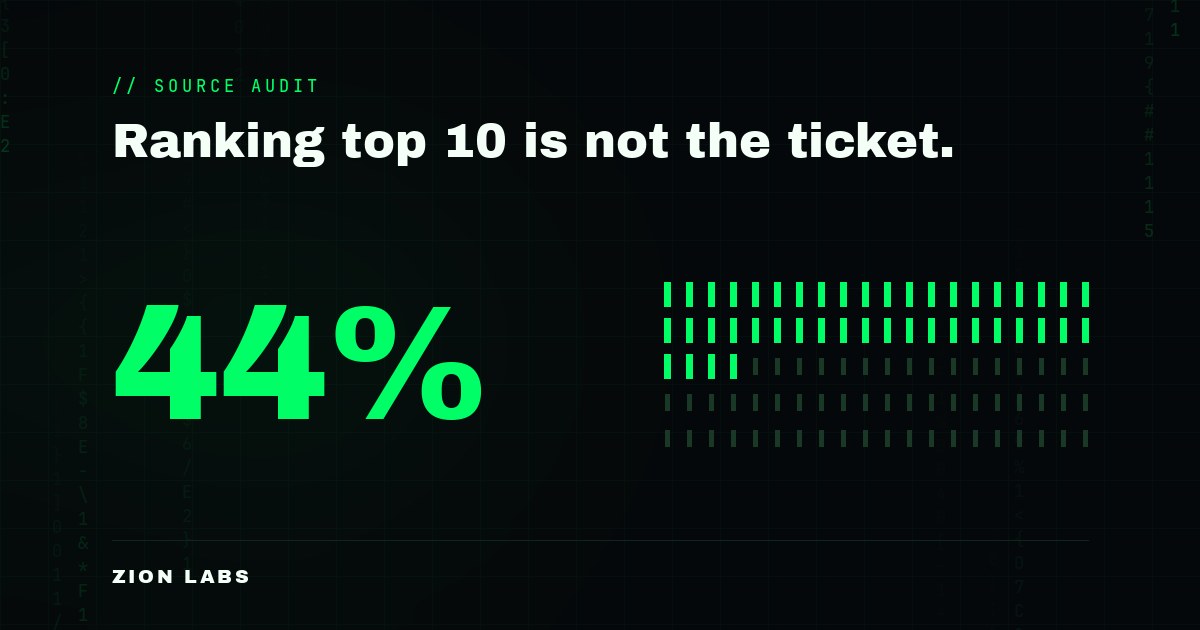
seoClarity, October 2025, across 362,000 US desktop queries, found AI Overview citations overlap the top 10 about 32% of the time, with 44% coming from beyond the top 20 entirely. That sits between Ahrefs’ figures and points the same way.
Then there is AirOps. As of August 2026, its published material contains at least three incompatible answers to this one question: that only 38% come from top 10 organic results, that roughly 60% come from outside the top 20, and elsewhere that 76% or more come from page one.
If 76% come from the top 10, at most 24% can come from beyond the top 20. Two of those three cannot both be true. None of the pages acknowledges the others, and the highest figure is the one published with no sample size, no date and no definition of ranking.
The honest version of the claim
Quote the 12% if you mean “does ranking for my query get me cited”. Quote the 38% or seoClarity’s 44% if you mean “do cited pages tend to rank well”. Name the study and the date either way, because this family of numbers has moved a long way in twelve months.
If you use the 76%, say it is from July 2025, say it describes cited pages rather than citations, and say the same publisher now reports 38% and 12% on adjacent questions.
The practical reading has not changed: ranking helps and does not decide. What has changed is that we can now put a number on how little it decides, and it is a lot lower than 76%.